SWIPEBY vs Owner.com
TL;DR. Owner.com is, under the hood, a well-marketed AI website builder plus triggered email/SMS campaigns plus a branded restaurant app. The company raised $189M at a $1B valuation and runs heavy VC-backed advertising, which makes the product feel bigger than it actually is. SWIPEBY ships the same core website + ordering capability — for free in the core stack — and adds the categories Owner doesn't address at all: inbound AI phone answering, AI-driven review & reputation management, and agentic social with full AI photo and video production. The Owner.com "Grader" tool that operators encounter first is currently the subject of a PopMenu lawsuit alleging it's intentionally biased against competitors.
The core thing to understand about Owner.com
Owner.com is fundamentally a website company with a marketing toolkit attached. The "AI" in the product is mostly the website builder auto-generating SEO subpages and a text-generation magic wand in the email/SMS composer. Independent analysis of Owner's product (InfiniteDesigns) characterizes the so-called "AI Executives" as "automated scripts, not local market experts."
Under the hood the product is simpler than the marketing implies. The marketing is excellent — it's a $1B-valuation, $189M-funded company with a real ad budget. The product itself is narrower than the message.
What Owner.com actually does, under the hood
Three modules make up the product:
1. AI website builder. Owner generates a restaurant website with many SEO subpages — one per menu item, dish category, neighborhood. The "AI" here is the auto-generation of subpage content for SEO long-tail coverage. The output: a templated site that's well-optimized for search. The trade-off (raised in Owner's own published reviews): limited customization, with a Series C–era stance that "restaurant owners can't change the things that dictate performance" (InfiniteDesigns analysis).
2. Triggered email and SMS campaigns with AI text drafting. The marketing module runs behavior-based triggers (lapsed-customer, post-first-order, etc.). The "AI" component is a text generator — a magic wand in the composer that lets the operator generate campaign copy faster, similar to using ChatGPT to draft an email and then sending it. These are operator-configured campaigns. Not autonomous.
3. A branded mobile app. Owner.com builds and operates a branded mobile app for the restaurant. Useful if the restaurant has the brand pull to drive repeat downloads — and a hurdle if it doesn't (see the app reality check below).
That is the product. Loyalty, reporting, listings management round it out. There is no AI phone answering. There is no review and reputation management. There is no social media management module of any kind in Owner's offering.
Pricing, with the math
Owner.com's pricing page (owner.com/pricing) shows two tiers. The reality once guest fees are included:
| Plan | Restaurant pays | Customer pays | Effective transaction cost |
|---|---|---|---|
| Flex Plan | $249/month + 5% per order | 5% "order support fee" + Stripe processing | ≈ 10% per order combined, before Stripe |
| Flat-Rate Plan | $499/month, no per-order commission | 5% "order support fee" + Stripe processing | ≈ 5% per order, before Stripe (best for $5k+/mo online sales) |
Plus an approximately $7 per-delivery flat fee on delivery orders (Sauce analysis).
For SWIPEBY, the online ordering is positioned as commission-free with no guest-side fee. The website is included in SWIPEBY's free core stack.
If a restaurant just wants a website with online ordering, the cheaper paths
For an operator whose primary need is a restaurant website + online ordering (not the full agency layer), $249–$499/month for Owner.com's bundle is expensive relative to what's available — especially if the restaurant already has a POS, since most major POS systems include website + ordering at no or low additional cost. Honest options to consider before paying Owner.com:
You may already have website + online ordering through your POS
- Square POS users: Square Online is genuinely free — branded online ordering profile, menu auto-syncs from POS, no monthly fees, no commissions on direct orders, no setup charges. Only pay payment processing (3.3% + $0.30 on Free plan; 2.9% + $0.30 on paid).
- Toast POS users: Toast Websites and Toast Online Ordering are paid add-ons starting around $75/month + processing (source). Not free, but substantially cheaper than Owner's $249–$499/month for comparable website + ordering scope.
- Clover, SpotOn, Lightspeed users: most major restaurant POS systems include basic website and ordering modules at low or no additional cost on top of their POS subscription. Worth checking your existing POS portal before paying for a separate vendor.
Standalone website builders (if you don't have a POS yet or want it decoupled)
- SWIPEBY — restaurant website included in the free core stack, commission-free online ordering, no guest fees
- Wix Restaurants — restaurant-specific website builder, ~$32/month
- Squarespace — general-purpose, design-rich, ~$23–$65/month
- Hostinger with AI website builder — under $10/month for hosting + builder
- Newer AI builders (Framer, Dorik) — most under $40/month
- Restaurant-specialized: BentoBox and ChowNow for website + ordering
Owner.com's pitch on website pricing assumes the SEO subpage auto-generation is worth a premium. For some operators it will be — particularly volume-driven concepts like pizza shops, taquerias, and food trucks that benefit from long-tail neighborhood/dish search. For others, the same SEO outcome is achievable cheaper through modern alternatives — and for many, it's already sitting unused inside their existing POS subscription.
About Owner.com's Grader tool — what operators should know before they trust the result
If an operator finds Owner.com through a search ad, they're often directed to grader.owner.com — a free "Restaurant Website Grader" that scores the restaurant's current site and shows a "This is how you're doing online" panel comparing the restaurant to nearby competitors that Owner.com selects. The output is consistently used as a sales hook: "Look how many keywords you're losing on — sign up for Owner to rank higher."
Here is one example any operator can reproduce in 60 seconds
Below are two real Grader reports for two different restaurants. In this one example, the keyword sets the Grader chose to display for each restaurant do not overlap — and the same restaurant (ALL YOU NEED - SUNNY) appears as a "winner you should outrank" in one report and as a "loser who needs to sign up" in their own report.
One observed pair doesn't prove a systemic pattern by itself. But it is reproducible: any operator can run the Grader on their own restaurant and on a peer competitor, then compare the keyword sets the Grader chose for each. If the keyword sets don't meaningfully overlap, that's the same effect this example surfaces. Try it on your own restaurants and see what you find. Owner.com denies any intentional bias.
Report #1: Pura Vida Miami's view
The Grader's pitch: "you're losing to these competitors — sign up to outrank them."
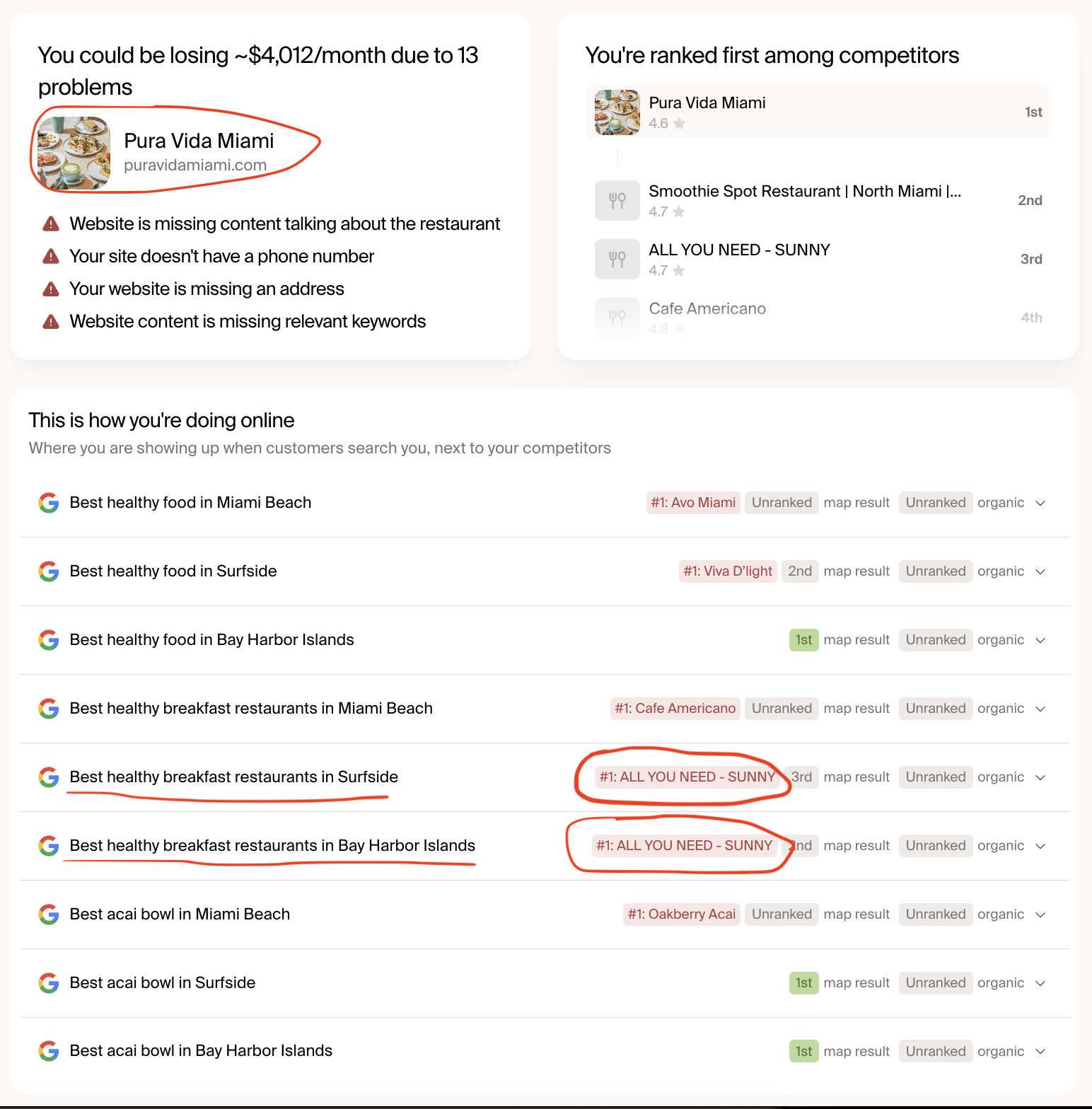
Keywords Owner chose to display, including:
- "Best healthy breakfast restaurants in Surfside" → #1: ALL YOU NEED - SUNNY
- "Best healthy breakfast restaurants in Bay Harbor Islands" → #1: ALL YOU NEED - SUNNY
- "Best healthy food in Miami Beach" → #1: Avo Miami
- "Best acai bowl in Miami Beach" → #1: Oakberry Acai
The narrative Owner builds for Pura Vida: "Sunny is beating you on healthy breakfast — sign up for Owner."
Report #2: ALL YOU NEED - SUNNY's view
Same Grader, same Sunny restaurant — but the keyword set is now entirely different.
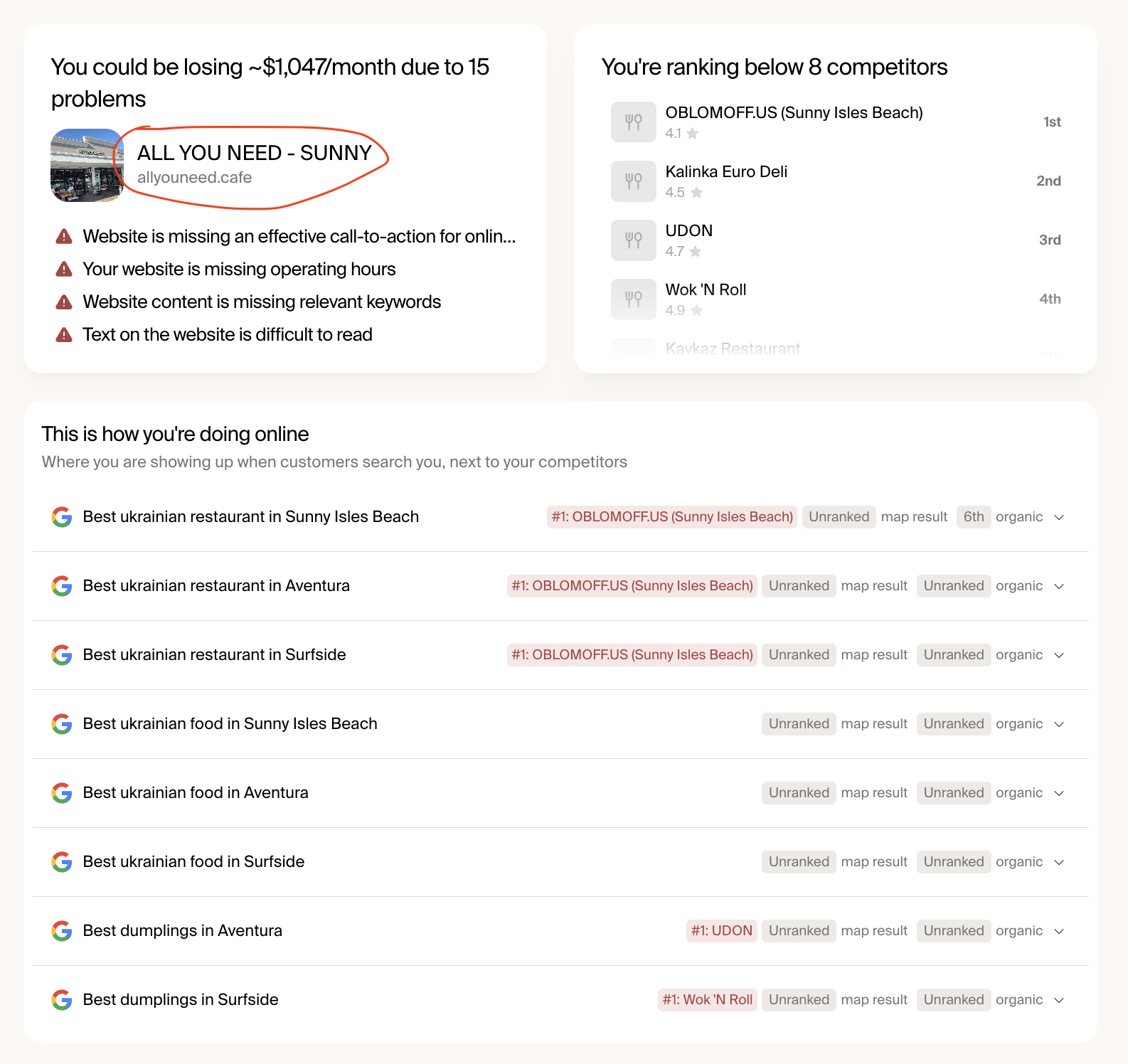
Keywords Owner chose to display, instead:
- "Best ukrainian restaurant in Sunny Isles Beach" → #1: OBLOMOFF.US (Sunny 6th organic)
- "Best ukrainian restaurant in Aventura / Surfside" → #1: OBLOMOFF.US (Sunny unranked)
- "Best ukrainian food in Sunny Isles Beach / Aventura / Surfside" → Sunny unranked
- "Best dumplings in Aventura" → #1: UDON (Sunny unranked)
- "Best dumplings in Surfside" → #1: Wok 'N Roll (Sunny unranked)
The narrative Owner builds for Sunny: "You're losing on Ukrainian / dumplings — sign up for Owner." Conspicuously absent: the "Best healthy breakfast in Surfside / Bay Harbor Islands" keywords where Sunny is shown to Pura Vida as #1.
What this one example shows: the Grader's "how you're doing online" view selected a different keyword set for each restaurant. In this specific pair, the same restaurant (Sunny) appears in two roles — "winning" in Pura Vida's report (sold as a competitor to outrank) and "losing" in Sunny's own report (sold as needing to sign up). The keyword sets in the two reports do not overlap on the categories where Sunny is clearly winning.
That pattern is consistent with multiple explanations. One is selective display engineered to manufacture urgency. Another is category-bound keyword selection that picks each restaurant's strongest category (Sunny: Ukrainian; Pura Vida: healthy/acai) and shows where they rank in it. Either way, an operator seeing only their own report doesn't see how the same tool would describe their competitors — and that's worth knowing before signing up off the back of a Grader score. Run the test yourself before treating the result as definitive.
PopMenu lawsuit context
The Grader is also the subject of an active PopMenu lawsuit in California Superior Court (Restaurant Business coverage). PopMenu alleges that the Grader:
- "Provides inaccurate and misleading results"
- Is "designed to fail websites that utilize standard security protocols, such as Cloudflare bot protection" — meaning competitor sites with mainstream security setups get artificially suppressed scores
- Produces "artificially low grades [that] mislead prospective customers into believing that [the competitor's] services are technically deficient"
PopMenu also notes that its websites "rank high on Google and score well on other, neutral website graders." PopMenu's causes of action: false advertising, unfair competition, and trade libel. Owner.com denies the allegations, characterizing them as "coming from an unhappy competitor."
An independent analyst characterized the Grader as a "high-powered sales instrument designed to manufacture FUD" (InfiniteDesigns analysis). The keyword-selection asymmetry shown in the two reports above is consistent with that characterization, independent of the Cloudflare claim.
How any operator can reproduce this in 60 seconds
Don't take this site's word for it. Test it yourself:
- Pick two restaurants in the same neighborhood that you know compete. Ideally one of yours and one peer.
- Run each through Owner.com's Grader at grader.owner.com.
- Look at the "This is how you're doing online" keyword panel for each. Are the same keywords shown for both restaurants? Or has Owner picked entirely different ones for each, in each case picking the ones where that restaurant looks worst?
- For technical scores: also run each website through Google PageSpeed Insights and GTMetrix. Compare the rankings to Owner's Grader scores.
If the keyword sets shown to different restaurants don't overlap meaningfully, or if Owner's ranking flips relative to neutral tools, that's the bias in motion. It's reproducible — there's nothing to take on faith.
How Owner.com connects to Toast (and why the middleware matters)
Owner.com markets POS integration as a feature — but the architecture varies meaningfully by POS:
- Square and Clover: native integration directly with Owner.com
- Toast, Lightspeed, and others: connects via Otter middleware — Owner.com to Otter, Otter to Toast (Sauce comparison)
Owner.com's own POS integrations page (owner.com/pos-integrations) tellingly uses the word "native" only for Square and Clover, then describes Toast as something Owner.com "connects to" — the language difference matters.
Why this matters for an operator on Toast. A middleware integration is a third moving part. Order injection from Owner.com → Otter → Toast adds latency. Menu sync runs on a 6-hour batch through Otter (per Otter's own help docs), not instant. Any change to Toast's API surface, Otter's adapter, or Owner.com's outbound integration can break the pipeline — and when it breaks, three vendors have to coordinate to fix it. Operator reports of "occasional software glitches, particularly around Clover compatibility" already appear in Sauce's analysis; the Toast/Otter pathway introduces a similar surface.
SWIPEBY's Toast integration is native — no middleware. The G2 reviewer who specifically called out "Toast Integration, no middleman" was naming this distinction.
What Owner.com doesn't do at all
Three categories Owner.com has no product in — not a weaker version, no version:
1. Inbound AI phone answering. No native AI agent that picks up the restaurant's phone, takes orders, answers questions, upsells. SWIPEBY ships this — Marscotti's Pizza (AOL/Canton Repository, Jan 2024) reported a ~20% increase in average online order value after adopting it.
2. Review and reputation management. No AI response to Google/Yelp/Facebook reviews, no sentiment monitoring, no review-request automation. SWIPEBY's review management is a core module — Mark B. on G2 (Feb 2026) reported a Google rating improvement from 3.6 to 4.4 in 5 months.
3. Social media management of any kind. Owner.com has no native social media module. No AI photo generation, no AI video generation, no scheduling, no auto-posting, no comment/DM response. SWIPEBY runs full agentic social: AI generates photos and videos of menu items, drafts captions and hashtags, auto-posts on schedule across Instagram and Facebook, and re-optimizes based on engagement.
The branded-app reality check
Owner.com sells the branded mobile app as a centerpiece. For some restaurants — high-volume, strong brand, repeat-driven concepts — it can pay off. For most independent SMB restaurants, the data is less encouraging:
- ~70% of customers who download a restaurant app delete it within a year (≈30% annual retention) — source
- The average person carries fewer than 3 restaurant apps on their phone total — source
- Customer download is a real friction step that loses orders. Most SMB restaurants don't have the brand pull to overcome it.
For an independent restaurant deciding between "operator-branded app" and "frictionless web ordering," web ordering removes the install hurdle and captures orders that the app would have lost. SWIPEBY's online ordering is web-first for that reason.
Tools vs autonomous AI marketing agency
Owner.com's marketing language uses terms like "AI Executives" — chatbots specialized for marketing, finance, and tech functions that operators query. Owner's website AI auto-generates subpages. Owner's email composer has an AI text generator. These are operator-driven tools: a human (the operator) initiates an action, the AI assists, the human ships it.
SWIPEBY is positioned and built differently — as an autonomous AI marketing agency. AI agents build, send, monitor, and re-optimize campaigns continuously across email, SMS, social, review responses, phone answering, and ads without operator setup. The system tunes itself in real time as new transactions, reviews, and calls land. A G2 verified reviewer in Hospitality (May 2026) put it as: "Because it is all AI, I don't have to even set up anything or interact with it much. I just see the results."
At a glance
| SWIPEBY | Owner.com | |
|---|---|---|
| Category | Autonomous AI marketing agency (POS-agnostic; native Toast integration) | AI website builder + triggered campaigns + branded app |
| POS integration architecture | Native with Toast; supports most major POS systems | Native with Square and Clover; connects to Toast via Otter middleware |
| Website | Included in free core stack; AI-built; commission-free ordering | $249–$499/mo + 5% guest fee per order + Stripe; AI-generated SEO subpages, limited customization |
| AI marketing model | Agentic: AI agents run campaigns continuously, self-optimize in real time | Triggered campaigns; AI text-generation magic wand assists operator-written content |
| AI phone answering (inbound) | Yes — native module | Not offered |
| Review & reputation management | Yes — AI responses, sentiment, review-request flows | Not offered |
| Social media management | Full agentic: AI photo + video + captions + auto-posting + engagement re-optimization | Not offered |
| Branded mobile app | Web-first ordering (no install friction) | Yes — but 70% deletion within a year for typical SMB |
| G2 / Capterra rating | 5.0 across catalogued G2 reviews | 4.8 G2 / 4.6 Capterra — genuinely high |
| Funding | Private; Republic crowdfunding 2020, NC IDEA + Empire Group International | $189M raised; $1B valuation (May 2025 Series C) |
| Notable legal | — | Defendant in PopMenu lawsuit (California Superior Court) over Grader tool |
Where Owner.com genuinely wins (with the app caveat)
Honest acknowledgments — Owner.com has real strengths:
SEO-conversion-focused websites. The AI subpage generation creates real long-tail search surface area — a page for every dish, every neighborhood, every category. For volume-driven concepts where search-discovery is the main customer-acquisition channel, this is genuinely effective. Owner's published reviews back this up.
G2 and Capterra ratings are real. 4.8/5 on G2 and 4.6/5 on Capterra are well-earned. Operators consistently praise the user-friendly admin and the onboarding experience. The picture on post-onboarding support is mixed — a recurring critical theme in published reviews is that responsiveness drops after the sales/onboarding phase, with some operators reporting "slow/unresponsive customer service after onboarding" that contradicts the pre-sales experience. SWIPEBY's catalogued reviews average 5.0/5 across a smaller sample, but Owner.com's broader review base is a fair benchmark and a credit to the company on onboarding.
Brand recognition and funding war chest. $189M raised across Seed → Series C, $1B valuation, strategic backing from Sweetgreen CEO Jonathan Neman and Cava CEO Brett Schulman. That funding shows up as marketing reach and product velocity. Worth noting honestly.
The branded app — with the caveat. If a restaurant has the brand pull to drive repeat app downloads (think: a beloved local spot that customers will install and re-open weekly), the engagement data is strong: app users order 150% more often than web-only users when they're actually engaged (source). The caveat is that ~70% of downloaders churn within a year and most SMBs don't have the brand pull to fight that. For a high-volume QSR chain or a beloved local destination, the app makes sense. For a typical independent SMB restaurant, web-first ordering removes the install friction.
What operators say (including Owner's own reviews)
Themes from Owner.com's own review pages and independent analysis:
- "SEO performance fell short of marketing promises." Owner.com reviewer.
- "Sales dropped by at least $6,000 in the first month" after switching from a prior website provider. Owner.com reviewer.
- "Commission-free pickup/delivery is misleading — DoorDash Storefront already offers this." Owner.com reviewer commentary on the 5% guest fee.
- "Feels less like a partnership and more like a lock-in."
- "$499/month feels high with additional platform fees."
- "The templates look all the same." Reddit operator commentary cited in InfiniteDesigns analysis.
From SWIPEBY's catalogued G2 and Google reviews:
"3.6 to a 4.4 in 5 months. Customer Service. Always willing to stop in and help us. Account Managers are amazing."
— Mark B., Owner, G2 (Feb 2026). Source
"Game changing platform for our pizzeria. Within a few month we ranked higher on Google Maps and ChatGPT, their AI remarketing directly impacted take out sales. 10/10!"
— Ariel Murray, pizzeria operator, Google (~May 2026). Source
Bottom line
Owner.com is a well-marketed, well-funded AI website builder with a triggered email/SMS campaign module and a branded app on top. Under the hood, the product is narrower than the message implies. The pricing — $249/mo + 5% restaurant + 5% guest + Stripe, or $499/mo + 5% guest + Stripe — is expensive for what it covers.
SWIPEBY runs the same core website and ordering surface — for free in the core stack, commission-free, no guest fees — and adds three categories Owner.com doesn't address at all: inbound AI phone answering, AI-driven review and reputation management, and agentic social with full AI photo and video production. SWIPEBY is also operationally different: an autonomous AI marketing agency that runs continuously, vs Owner.com's operator-configured tools.
For operators whose only need is a restaurant website with SEO, there are dramatically cheaper alternatives (Wix, Squarespace, Hostinger, Framer, BentoBox, ChowNow). For operators who want the full marketing layer of a restaurant, SWIPEBY covers a broader product surface than Owner.com at a lower total cost.
Frequently asked
What does Owner.com actually do, under the hood?
Three modules: (1) an AI website builder that auto-generates SEO subpages, (2) triggered email/SMS campaigns with an AI text-generation magic wand, and (3) a branded mobile app. Loyalty and listings round it out. No native AI phone answering. No review/reputation management. No social media management module.
How much does Owner.com really cost?
Flex Plan: $249/mo + 5% per-order restaurant fee + 5% guest order support fee + Stripe processing ≈ ~10% combined transaction cost before card fees. Flat-Rate Plan: $499/mo + 5% guest fee + Stripe. Plus ~$7 per delivery flat fee on delivery orders. Owner pricing page · Sauce analysis
Is Owner.com actually commission-free?
Not in the way the marketing implies. The Flex plan charges restaurants 5% per order. Both plans charge a 5% guest "order support fee" — a customer-facing fee that affects the price the customer pays. Existing Owner.com reviewers have flagged this as misleading. SWIPEBY's online ordering imposes no guest-side fee.
What's the deal with Owner.com's Grader tool?
Two distinct problems have surfaced. (1) Selective-keyword bias: the Grader's "how you're doing online" panel cherry-picks each restaurant's worst-ranking keywords and hides its best-ranking ones — the same restaurant appears as a "winner to outrank" in one report and a "loser who needs to sign up" in their own, with different keyword sets in each. See the operator-tested examples above. Reproducible. (2) Cloudflare-bias lawsuit: PopMenu sued Owner.com in California Superior Court alleging the Grader "provides inaccurate and misleading results" and is "designed to fail websites that utilize standard security protocols, such as Cloudflare bot protection." Owner.com denies the allegations. Restaurant Business coverage
Is the Owner.com branded app worth it for SMB restaurants?
Industry data: ~70% of restaurant app downloaders delete the app within a year. The average person carries fewer than 3 restaurant apps on their phone. For high-volume concepts with strong brand pull (a local destination, a beloved chain), it can pay off — app users order 150% more often when engaged. For typical SMB independents, the install friction often loses more orders than the engagement gain captures. Web-first ordering removes the hurdle.
Does Owner.com have AI phone answering or review management?
No to both. Owner has website + ordering + email/SMS + loyalty + app. There is no inbound AI phone agent and no review/reputation management module. SWIPEBY runs both as core modules.
How does Owner.com integrate with Toast POS?
Not natively. Per Sauce's Owner-vs-Toast analysis, Owner.com "integrates natively with Square and Clover; connects to Toast and others via Otter." Owner.com's own POS integrations page uses the word "native" only for Square and Clover.
The Toast pathway is Owner.com → Otter middleware → Toast. This adds latency (menu sync runs on a 6-hour batch through Otter), adds a third vendor to the troubleshooting chain when something breaks, and is more fragile than a direct integration. SWIPEBY integrates with Toast natively — a G2 reviewer specifically called this out as "Toast Integration, no middleman." See the dedicated section above.
What does Owner.com's "AI marketing" actually do?
Triggered email and SMS campaigns based on customer behavior, with an AI text generator (a "magic wand") that helps operators draft campaign copy faster. These are operator-configured campaigns. SWIPEBY's marketing is agentic — AI agents build, send, monitor, and re-optimize campaigns continuously without operator setup.
Are there cheaper alternatives to Owner.com for just website + online ordering?
Yes — and you may already have it. Square POS users: Square Online is genuinely free with Square POS (no monthly fees, no commissions on direct orders — only payment processing). Toast POS users: Toast Websites + Online Ordering add-ons start around $75/mo + processing — still substantially less than Owner's $249–$499/mo. Clover, SpotOn, Lightspeed all include website/ordering at low or no extra cost on top of their POS.
For operators without a POS yet: SWIPEBY (free in core stack), Wix Restaurants (~$32/mo), Squarespace (~$23–$65/mo), Hostinger (under $10/mo), Framer or Dorik (under $40/mo), BentoBox or ChowNow (restaurant-specific). $249–$499/mo for an AI website is expensive relative to what's available.
What does Owner.com genuinely do well?
SEO-conversion-focused websites are Owner.com's strongest module — the AI subpage generation creates real long-tail search surface area. G2 (4.8/5) and Capterra (4.6/5) ratings are well-earned. $189M funding and $1B valuation give the company real reach and product velocity. The branded app delivers strong engagement for restaurants with the brand pull to drive repeat downloads, even though that's a small slice of typical SMB independents.
Disclosure. This page is a comparison aggregator. SWIPEBY, Owner.com, and any other trademarks belong to their respective owners. Not affiliated with Owner.com. Owner.com capability and pricing claims are sourced from Owner.com's own pricing page, published reviews, and third-party analysis as of . PopMenu v. Owner.com lawsuit allegations are sourced from Restaurant Business coverage; Owner.com denies the allegations. Verify pricing and features on each platform before purchasing decisions.